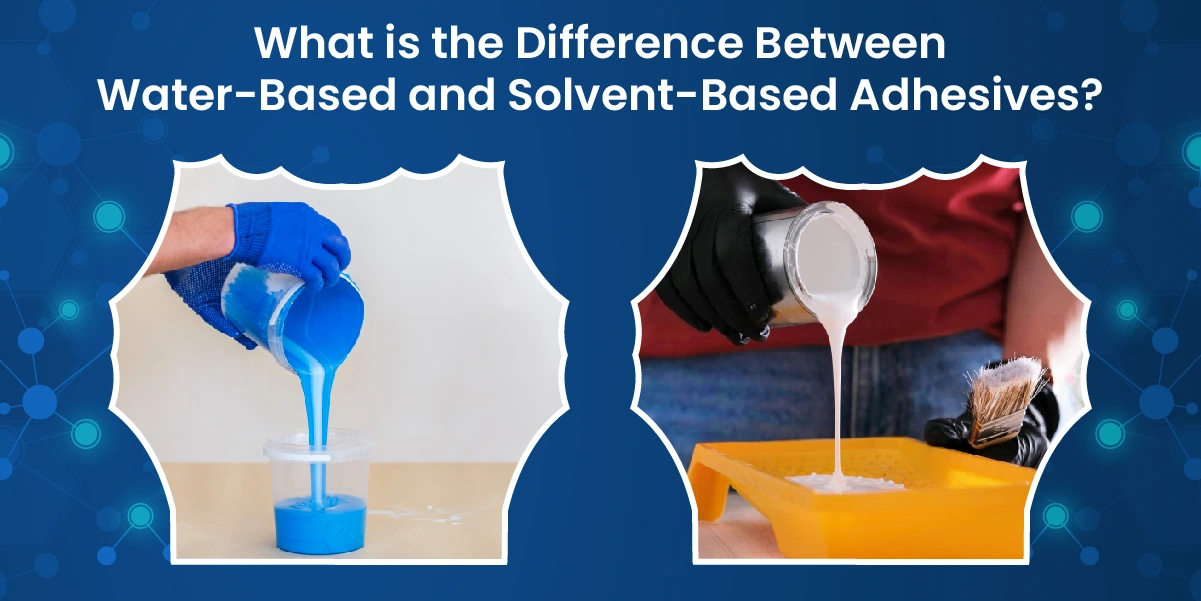
A plant manager may want to reduce VOC emissions, simplify safety requirements, and control operating costs. But switching from solvent-based to water-based adhesives can raise concerns about green tack, open time, drying speed, and bonding on non-porous surfaces.
So, what is the difference between solvent-based and water-based adhesive systems? The answer is more than simply the carrier used. The right choice depends on the substrate, surface energy, drying infrastructure, production speed, worker safety, and total cost of ownership. This guide explains the difference between water-based and solvent-based adhesives, compares eight technical factors, covers common production problems, and provides a six-step framework for choosing the right system.
A] How Water-Based and Solvent-Based Adhesives Work
1. Solvent-Based Chemistry
Solvent-based adhesives employ organic solvents such as ethyl acetate, toluene, MEK, or acetone as a carrier. The solvents are able to dissolve polymers such as polychloroprene, SBS/SIS, and certain polyurethane systems.
During application, the solvent serves to allow the adhesive to be workable while providing good wetting of the substrate. Once evaporated, the polymer is left, forming an adhesive film. On the other hand, depending on the formulation and substrate, the interaction of a solvent with a substrate can improve wetting and adhesion of such materials as plastics and rubbers.
The fast drying characteristics can make solvent-based systems suitable for applications that require rapid bonding and good performance on non-porous substrates.
2. Water-Based Chemistry
Water-based adhesives utilize water as a carrier for polymer dispersions or emulsions for their binding properties. Common chemistries include: PVAc, VAM-acrylics, acrylics, PUDs and EVA emulsions.
The polymer in these dispersions takes the form of tiny particles suspended in water. These tiny polymer particles then fuse together (a process called coalescing) as the water evaporates or is absorbed into a porous substrate to form a binding film.
The final bond depends strongly on film formation, temperature, humidity, substrate porosity, and drying conditions. This is why water-based vs solvent-based adhesives should always be evaluated against the actual production process.
3. Red Flags
Using water-based adhesive between two non-porous substrates without sufficient forced-air or infrared drying. Using solvent-based adhesive without suitable ventilation, ignition-control measures, and solvent-handling systems.
B] Water-Based vs. Solvent-Based Adhesives: Head-to-Head Technical Comparison
There is no universal winner when comparing water-based adhesives vs. solvent-based adhesives. Each system offers different advantages depending on the application.
| Parameter | Water-Based Adhesives | Solvent-Based Adhesives |
| Carrier Vehicle | Primarily water | Organic solvents |
| Solids Content Range | Formulation-dependent | Formulation-dependent |
| Green Tack & Open Time | Can be tailored for different open times and tack levels | Often supports fast setting, depending on chemistry |
| Substrate Penetration | Effective on many porous substrates; non-porous bonding may need controlled drying | Often suitable for non-porous and difficult substrates, depending on formulation |
| VOC Profile | Generally lower VOC emissions, depending on formulation | Typically higher VOC emissions due to organic solvents |
| Flammability Risk | Usually lower, but the complete formulation must be checked | Can have significant flammability risk |
| Drying Requirement | May require more controlled drying, especially on non-porous surfaces | Often benefits from faster solvent evaporation |
| Clean-up | Often possible with water or suitable cleaning agents before full drying | Usually requires compatible solvent-based cleaning methods |
The right solvent-based adhesive vs. water-based adhesive comparison should always be based on the specific formulation and production conditions.
C] Which Adhesive Matches Your Substrates?
1. Paper, Packaging & Converting
Water-based PVAc, EVA, and acrylic adhesive systems are widely used for paper and packaging because they can provide good wetting and bonding on porous materials. Their performance can depend heavily on line speed, coat weight, paper absorbency, temperature, and humidity.
Drying becomes difficult under high humidity conditions. Additional air circulation or heating in the drying chamber may be required along with adjustments in production rate and adhesive application rates. These same considerations apply when choosing a water-based adhesive for high-speed converting.
2. Woodworking & Furniture Assembly
Waterborne PVAc systems, including crosslinking grades, are often considered for bonding to wood due to the open porous structure, which allows penetration of the adhesive and good mechanical performance.
For demanding applications, factors such as water resistance, heat resistance, open time, pressing conditions, and clamp time should be evaluated. In colder production environments, the adhesive’s minimum film formation temperature (MFFT) also becomes important.
3. Automotive, Footwear & Rubber Bonding
Solvent-based polyurethane and polychloroprene systems may be used where strong initial tack, fast setting, or bonding to rubber and other difficult substrates is required. Specialised water-based PUD systems can also be considered where lower solvent emissions are a priority. For export-oriented applications, manufacturers may also need to consider VOC, odour, chemical restrictions, and customer-specific compliance requirements.
4. Flexible Packaging & Film Lamination
Flexible packaging has seen increasing interest in solventless and water-based technologies. The choice depends on film type, coating weight, line speed, drying capacity, food-contact requirements, and the final bond performance required. Working with an experienced Polymer Company can also help manufacturers identify polymer systems suited to their specific adhesive application.
D] Common Production Problems and How to Troubleshoot Them
Many adhesive problems are caused by a mismatch between the adhesive, substrate preparation, application method, and drying conditions rather than by the adhesive chemistry alone.
| Problem | Possible Cause | Troubleshooting |
| Blistering / Film Tunneling | Moisture or residual water trapped between non-porous layers | Improve drying, airflow, nip timing, and open-time control |
| Substrate Distortion / Warping | Excess moisture entering moisture-sensitive materials | Review adhesive coat weight, solids content, drying conditions, and substrate response |
| Adhesion Failure on Plastics | Low surface energy or poor wetting | Consider corona/plasma treatment and a suitable adhesive or wetting approach |
| Joint Degradation Over Time | Incomplete drying, unsuitable adhesive-substrate combination, or solvent interaction | Check flash-off, drying zones, substrate compatibility, and long-term ageing requirements |
Most issues in solvent vs water-based adhesive applications can be reduced by matching the adhesive with the substrate and production process.
E] Total Cost of Ownership (TCO) Beyond Per-Kilo Price
Comparing adhesives only by price per kilogram can give a misleading picture. The actual cost depends on how much adhesive is required to create the required bond and what infrastructure is needed to run it.
1. Unit Price Illusion
A lower-cost solvent-based adhesive may not necessarily deliver the lowest cost per finished product. Compare the actual solids content, wet coat weight, dry coat weight, coverage, application efficiency, and production speed.
2. Hidden Solvent Expenses
Solvent-based systems can require additional investment in ventilation, ignition control, explosion-protected equipment, solvent handling, storage, waste management, and worker protection. Depending on the plant and local requirements, these factors can significantly affect operating costs.
3. Water-Based Considerations
Water-based systems can cut solvent-handling requirements and provide benefits in terms of workplace exposure and regulatory control but may require additional drying capacity, such as when bonding non-porous substrates or operating at very high line speeds.
For businesses considering solvent-based vs. water-based adhesives, a proper comparison of total cost of ownership would include adhesive consumption, solids, drying energy, line speed, ventilation, maintenance, waste, safety requirements, and compliance costs.
For manufacturers looking for suitable adhesives, Soham Polymers provides adhesive-related polymer solutions through its Adhesives Manufacturer range.
F] Pre-Approval Decision Checklist for Plant & R&D Teams
Before approving a water-based or solvent-based adhesive, review these six points:
- Substrate Porosity: Is at least one substrate porous, or is forced-air/infrared drying available for non-porous bonding?
- Temperature: Has the adhesive’s MFFT been checked against actual production conditions?
- Solids & Coverage: What are the active solids percentage and required wet-to-dry coverage?
- Surface Energy: Has the substrate’s surface energy and wetting behaviour been measured?
- Compliance: Does the adhesive meet applicable VOC, chemical, customer, and brand-owner requirements?
- Process Support: Is technical support available for viscosity, coat weight, drying, and inline process optimisation?
Conclusion
Understanding the difference between water-based and solvent-based adhesive systems requires looking beyond the carrier. Substrate, drying conditions, application speed, safety, compliance, and total cost all influence the final choice. Water-based adhesives can offer advantages where lower solvent emissions and easier handling are priorities, while solvent-based systems can remain useful where fast drying, specific substrate compatibility, or high initial tack is required. The right approach is to evaluate the complete application rather than relying on general assumptions.