

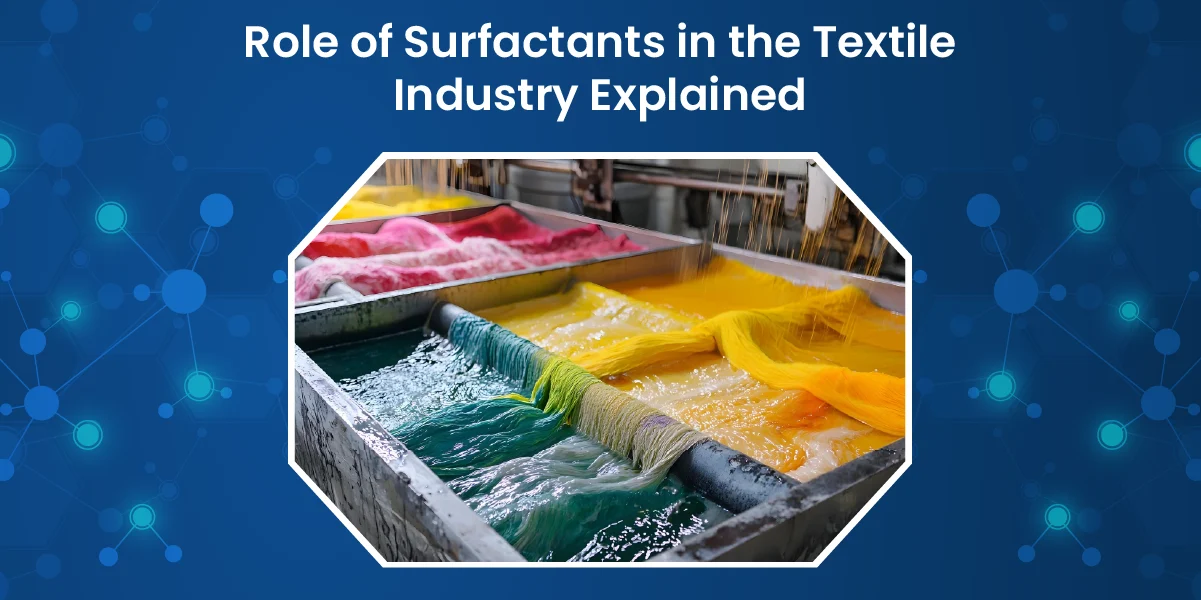
Why does one fabric absorb dye perfectly while another ends up patchy or dull? In the majority of cases, it is not the fibre but the chemistry that determines the outcome. Surfactants, which are usually not given much attention by non-technical teams, are the silent force behind efficiency and quality in textile operations.
Surfactants, at their simplest, decrease surface tension so that water and chemicals can effectively interact with textile fibres. But in practice, surfactants in the textile industry do far more than that. They affect the cleaning of fabrics, the penetration of dyes, and the application of finishes.
To manufacturers who do it on a large scale, this is not chemistry, but economics. Textile processing can use the right surfactants to minimise defects, enhance consistency, and support sustainability efforts. This is why the role of surfactants in the textile industry is ever-increasing as the production standards become stricter in the world.
A] Why Surfactants Are Essential in Textile Processing
If you strip textile processing down to its fundamentals, it’s all about interaction between water, chemicals, and fibres. The problem? These elements don’t naturally work well together. That’s where surfactants step in.
Their molecular structure allows them to stabilise oil and water phases, making it easier to remove impurities and evenly distribute chemicals. Without this function, even basic steps become unreliable.
Think about the consequences:
- Water is sitting on the fabric instead of spreading
- Dyes clustering in certain areas
- Residual oils interfere with the final finish
This is precisely where the role of surfactants in textile processing becomes non-negotiable. They ensure that every stage from scouring to finishing happens uniformly.
Beyond cleaning, the functions of surfactants in textile processing include dispersing dyes, stabilising formulations, and improving penetration into fibres. These aren’t minor improvements; they directly affect rejection rates and production timelines.
When manufacturers talk about consistency, they’re really talking about control. And control, in large part, comes from choosing the right surfactant system. That’s the real importance of surfactants in the textile industry: they turn variability into predictability.
B] Key Applications of Surfactants in the Textile Industry
Where exactly are surfactants used, and how do they impact real-world textile manufacturing? The applications of surfactants in textile manufacturing are multiphase processes that affect the quality of the final fabric.
1. Pre-treatment (Wetting & Scouring)
Before dyeing begins, fabrics must be cleaned thoroughly. Surfactants act as wetting agents, ensuring water penetrates fibres quickly. They also remove oils, waxes, and impurities during scouring.
This is one of the most critical applications of surfactants in textile manufacturing, because improper pre-treatment leads to defects later. The right wetting process ensures uniform chemical absorption, which in turn ensures high-quality dyeing.
2. Dyeing & Printing
Ever wondered why some fabrics show uneven shades? It often comes down to poor dispersion. Surfactants help distribute dyes evenly across fibres, preventing agglomeration.
The role of surfactants in textile processing during dyeing is to ensure colour uniformity, brightness, and fastness. This is particularly important in large-scale operations where even minor inconsistencies can lead to major losses.
3. Dispersing & Emulsifying
Textile processing involves oils, pigments, and chemicals that don’t naturally mix with water. Surfactants act as dispersing and emulsifying agents, stabilising these mixtures.
The functions of surfactants in textile processing here ensure that formulations remain consistent, reducing defects and reprocessing. This directly improves efficiency and reduces waste.
4. Finishing Processes
In finishing, surfactants help apply softeners, water repellents, and functional coatings evenly. Whether it’s achieving a silky texture or enhancing durability, surfactants ensure proper distribution.
Modern manufacturers increasingly rely on surfactants in textile manufacturing to achieve advanced finishes like stain resistance or moisture management.
Companies like Soham Polymers, with over 25 years of expertise, develop customised textile chemical solutions that enhance fabric quality, durability, and sustainability, demonstrating how innovation drives better outcomes in real-world applications.
C] Types of Surfactants Used
Not all surfactants are the same, so which ones are used in textiles? The answer is determined by the procedure and required result. Understanding the surfactants used in the textile industry helps manufacturers choose the right solution.
- Anionic Surfactants: Excellent for cleaning and scouring due to strong detergency
- Non-ionic Surfactants: Widely used for wetting and emulsifying; stable across pH levels
- Cationic Surfactants: Ideal for fabric softening and conditioning
- Amphoteric Surfactants: Versatile and mild, often used in specialised applications
Each type plays a unique role in surfactants in textile processing, ensuring compatibility with different fibres and chemicals. The choice of the type has a direct influence on the efficiency and end performance of the fabric.
D] Benefits for Textile Manufacturers
Why should manufacturers invest in high-quality surfactants? Because the benefits of surfactants in textile processing go far beyond basic functionality.
Here are the reasons why manufacturers should invest in high-quality surfactants:
- Improved fabric quality with uniform texture and colour
- Reduced reprocessing, saving time and resources
- Enhanced cost efficiency through optimised chemical usage
- Consistency in bulk production is critical for exports
- Eco-friendly processing with reduced water and energy consumption
The “why surfactants are important in the textile industry” becomes clear when you consider scalability. Can a manufacturer afford inconsistencies in large batches? Absolutely not.
By integrating advanced surfactants in textile manufacturing, businesses can meet global quality standards while maintaining operational efficiency.
E] Choosing the Right Surfactant Supplier
Selecting the right partner is just as important as choosing the right chemical. So, always look for:
- Customisation capability for specific textile processes
- Strong technical support and application expertise
- Uninterrupted quality of products within batches.
- Focus on sustainable and eco-friendly solutions
Working with a speciality chemical partner like Soham Polymers ensures optimised formulations that are customised for individual textile processes and fibre types. Backed by decades of R&D and sustainable manufacturing practices, the solutions support more stable production, reduce defects, and enhance fabric performance.
Conclusion
In today’s textile industry, surfactants sit quietly behind the scenes but decide whether a batch runs smoothly or turns into rework. From the first wetting and scouring stage through dyeing, printing, and finishing, they help chemicals reach fibres evenly and do their job properly. This means cleaner fabrics, clearer shades, and fewer surprises on the production floor.
When manufacturers choose the right surfactant system and a supplier who understands their processes, they get more than chemistry. They gain control over quality, lower operational costs, and a more sustainable way of working at an industrial scale.